

Let’s be honest: the word “sustainability” has lost some of its punch. Once a rallying cry for innovation and responsibility, it’s now often met with eyerolls or skepticism. Overused in marketing, politicized in public discourse, and diluted by vague commitments, the term has become a catch-all that risks meaning everything—and nothing. But beneath the buzzword fatigue lies a very real and urgent business imperative. When approached strategically, sustainability isn’t just about optics—it’s about meeting stakeholder expectations, building resilient businesses, and creating long-term value.
In today’s rapidly evolving business landscape, sustainability is no longer a “nice to have”—it’s a strategic imperative. Whether driven by regulatory mandates, investor expectations, or customer demands, companies are increasingly expected to demonstrate environmental and social responsibility. Yes, these pressures have been there – bad news is they are not going away. Good news is you can still satisfy these stakeholder expectations and improve the bottom line – something your stakeholders will like as well. Beyond compliance, sustainability offers a powerful opportunity to unlock operational efficiencies, enhance brand reputation, and create long-term value.
At Bridge House Advisors, our Sustainability Strategy & Reporting Services are designed to help companies navigate this complex terrain while still adding value to their organizations. Here’s how we guide organizations through three critical pillars of sustainability success: understanding the drivers to act, identifying what matters most through materiality assessments, and leveraging sustainability for real business impact.
- “You’re Not Choosing Sustainability—It’s Choosing You”
Sustainability efforts & reporting/disclosures are not optional. When we sit down with customers, we typically see these external forces creating the drivers to act. These need to be understood so that whatever outcomes your Sustainability Program produces – it must satisfy these expectations – especially the regulatory ones!
- Regulatory Pressure: New and evolving regulations are compelling companies to act. For example, California’s climate disclosure laws require companies with over $1 billion in revenue to report Scope 1 and 2 greenhouse gas emissions by 2026 (with limited assurance), and Scope 3 by 2027. Similarly, the EU’s Corporate Sustainability Reporting Directive (CSRD) will impact over 60,000 companies globally.
- Customer Expectations: Large corporations like Walmart, Amazon, and Meta are increasingly requiring their suppliers to report on sustainability metrics or complete third-party assessments like EcoVadis or CDP. This pressure is especially intense in sectors like food and beverage, consumer packaged goods, health and beauty, and consumer electronics, where brand reputation and regulatory scrutiny are tightly linked to supply chain practices. These expectations are cascading down the value chain, making sustainability not just a competitive advantage—but a business requirement.
- Investor and Owner Demands: Private equity sponsors and institutional investors are asking portfolio companies to collect and report ESG data. This is not just about transparency—it’s about risk management and long-term value creation.
While these external pressures are often the initial catalyst, they open the door to deeper conversations about how sustainability can drive internal improvements and competitive advantage.
- Materiality Assessment: Finding What Matters Most
A cornerstone of our approach is the materiality assessment—a structured process to identify and prioritize the environmental, social, and governance (ESG) topics that are (a) most relevant to a company’s stakeholders and business strategy and (b) where a company may have external impacts to the environment, community, or people in relation to a given topic.
This process includes:
- Stakeholder Engagement: We engage both internal leaders and external stakeholders (e.g., customers, investors, community groups) to gather insights on what issues matter most.
- Benchmarking and Framework Alignment: We review industry standards (like IFRS/SASB, GRI, IFRS S2/TCFD) and peer practices to ensure alignment with best-in-class expectations.
- Prioritization and Visualization: Using stakeholder input and data analysis, we establish a list of material topics that are the company’s most critical focus areas.
For example, one visualization option was to create materiality “bands” focusing on Impact and Importance. In this situation, the exercise highlighted data security, employee health & safety, energy management, and waste/water management as top priorities—areas that not only matter to stakeholders and provide tangible business benefits in addition to where the company has a potential external impact.
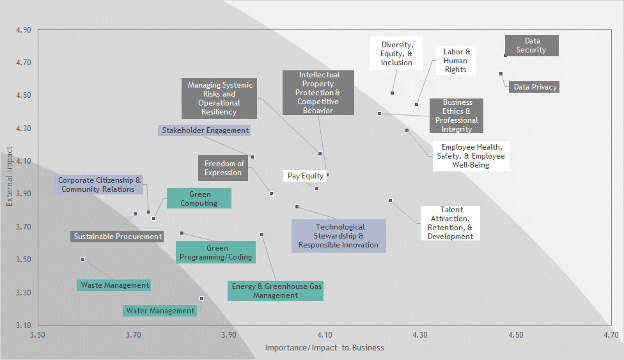
This assessment becomes the foundation for a tailored sustainability strategy, ensuring that efforts are focused, measurable, and aligned with business goals. Each priority area is assigned action steps with dates, deliverables, and the necessary KPI’s. Value creation potentials are sized appropriately and become a part of the overall Sustainability Roadmap and Reporting Efforts.
- From Compliance to Competitive Advantage: Real Business Value
While sustainability efforts often begin as a response to external drivers, they frequently uncover real opportunities for operational improvement and value creation. Here are just a few examples:
- Health & Safety: Companies that prioritize employee well-being see lower injury rates, reduced absenteeism, and higher productivity. This can translate to 50% reduction in injury-related costs and 14% increase in productivity (EHS Compliance – Beyond Risk)
- Data Security: With increasing cyber threats, robust data privacy and cybersecurity practices are not just regulatory requirements—they’re essential for maintaining customer trust and avoiding costly breaches.
- Energy Management: Implementing energy efficiency measures can significantly reduce operating costs. In our experience, 20-30% reduction in energy spend per facility can be achieved through low/no-cost changes to processes like Operations & Maintenance (O&M) and Continuous Improvement (CI) (Carbon Accounting)
- Waste & Water Management: Reducing waste and improving water efficiency not only lowers environmental impact but also cuts disposal and utility costs. For example, companies in manufacturing and food & beverage sectors often find quick wins in these areas.
These initiatives don’t just satisfy regulators and customers—they also enhance employee engagement, attract top talent, and improve overall brand recognition.
A Roadmap for Sustainable Success
Sustainability is not a one-size-fits-all journey. That’s why our approach is built around flexibility, collaboration, and continuous improvement. Whether you’re responding to a customer survey, preparing for regulatory disclosures, or proactively building a sustainability program, we help you:
- Establish a strong foundation
- Identify and prioritize material ESG topics
- Develop a strategy and roadmap tailored to your business
- Report progress transparently and effectively
The result? A sustainability program that not only meets external expectations but also drives real business value—keeping your customers, owners, and regulators happy while building a smarter, more resilient business.
Contact us to learn more or how we can fix your Sustainability Program.