


For years, private equity firms have navigated a rapidly evolving ESG landscape driven first by investor expectations, followed by 3rd party disclosure frameworks, and then regional regulatory pressure. Frameworks such as the UN Principles of Responsible Investment (PRI), ESG Data Convergence Initiative (EDCI), Task Force on Climate Related Financial Disclosures (TCFD), and the EU’s SFDR (Sustainable Finance Disclosure Regulation) have become standard guidance for understanding broad investor and fund level ESG performance. These frameworks are essential to maintain LP confidence, enable access to capital during fundraising, and drive policy adoption. All good things. However, these frameworks only provide an “outside in” view—useful for macro understanding—but can sometimes be disconnected from the day-to-day operational decisions and execution of the businesses that ultimately drive EBITDA.
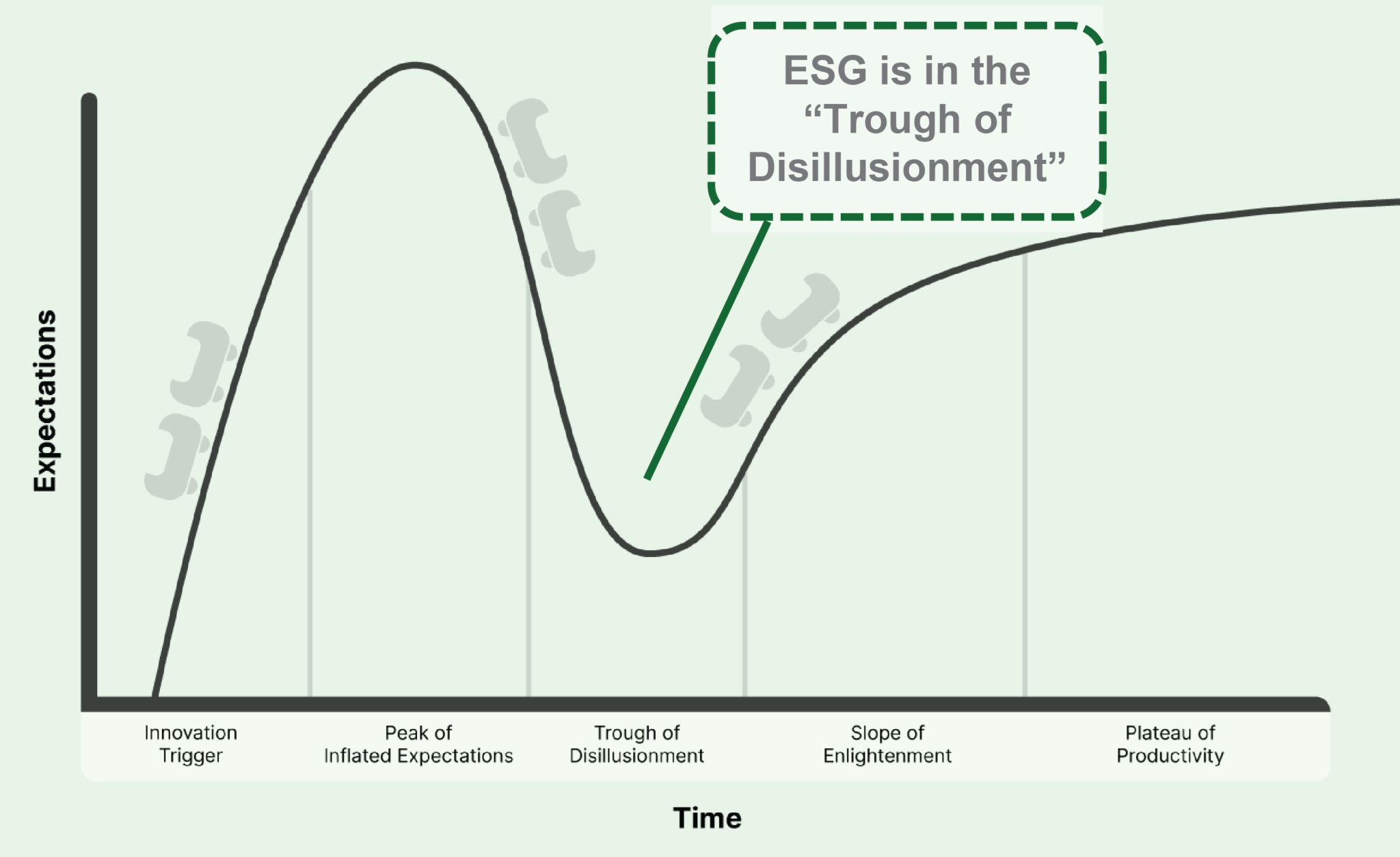
This is where many investment firms get stuck. They invest in ESG programs, reporting systems, and policies, but struggle to translate that work into tangible operational outcomes and business value. This “Now what?” moment, combined with anti-ESG sentiment in the US markets, led to one of our clients illustrating this as the “ESG Trough of Disillusionment”1. What is the best way forward on the ESG Maturity journey? How can all this ESG investment drive value creation?
Bridge House Advisors’ approach focuses on providing answers specifically to these questions. Building better, more resilient, competitive businesses with smart choices about ESG and sustainability.
Beyond Disclosure: ESG as an Operational Engine
Bridge House Advisors has built its foundation on delivering high-quality, reliable pre-investment Due Diligence services. This foundation has since expanded into services that deliver fit-for-purpose, firm level ESG management programs which help investors unlock capital from ESG-minded LPs. These services, in turn, provide both touchpoints and insights into the operations of portfolio companies, where Bridge House can apply its expertise across organizational professionalization, continuous improvement, and operational efficiency. In focusing on operational excellence, Bridge House goes beyond meeting compliance and reporting expectations. We help the portfolio companies move the financial needle.
These integrated capabilities are critical to helping our clients, both investors and portfolio companies, move past this “ESG Trough of Disillusionment”.
Unlike conventional ESG advisors who remain focused on reporting, Bridge House takes an “operations first” approach designed to activate ESG as a driver of risk reduction, margin expansion, and revenue growth, addressing what truly motivates portfolio company leadership: operational performance, productivity, and scalability of their business.
Identifying the ESG Levers That Drive EBITDA
The “inside-out” operationally focused approach is at the core of what our private equity clients do: create business value from their investments and ESG professionals must follow suit. Value creation in private equity relies on a finite set of levers tied to the financial governance, leadership, and SIPOC—suppliers, inputs, processes, outputs, customers—of the business. Every PE investment thesis activates certain “deal team” levers based on the industry vertical and investment’s growth strategy.
Hidden within these “deal team” levers are ESG-aligned opportunities that can meaningfully amplify operational and financial performance if correctly identified and executed. These opportunities often sit in core business areas such as:
- Operational excellence
- Safety and workforce retention
- Supply chain resilience
- Product design, quality, and safety
- Financial and ethical governance
The following table illustrates how various ESG topics, both risks and opportunities, can be mapped to corporate functions that have leadership, accountability, performance goals, and budgets! Focusing on the ESG considerations that line up with the deal team’s value creation agenda, and mapping to existing corporate functions enables incremental ESG value creation and avoids the trap associated with ESG and sustainability “speak” that is not grounded in business fundamentals.
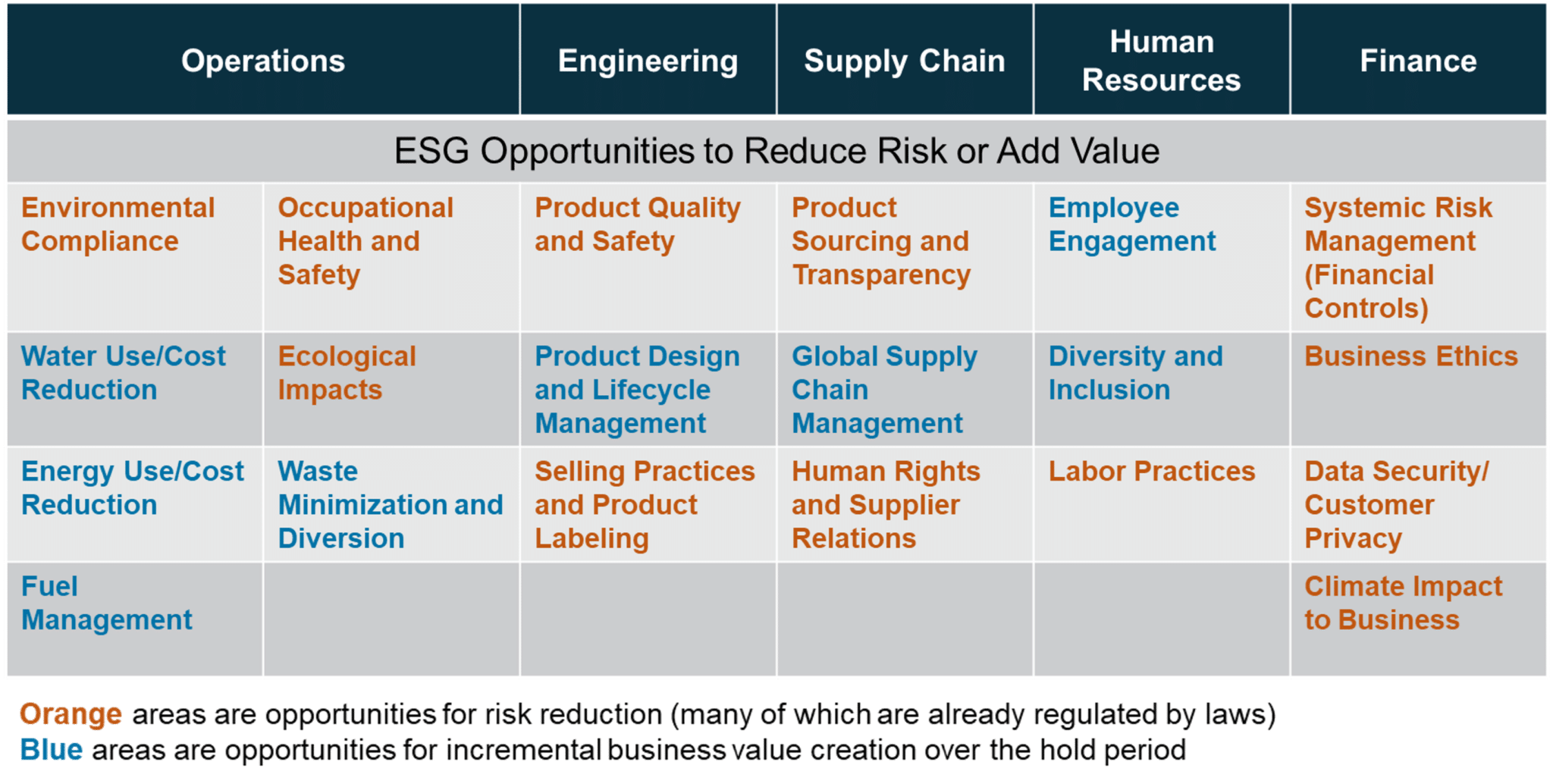
These opportunities often do not require capital expenditure and can be implemented well within the timeframe of the traditional PE hold period. However, it’s one thing to identify and assess the appropriate levers. It’s a whole other thing to deliver on them. When activated strategically, and aligned with deal team priorities, ESG can become a catalyst for building “a bigger, better, safer company”—one whose operational maturity directly translates to EBITDA expansion over time. Embedding these ESG opportunities into the fabric of business operations is key.
This is the backbone of Bridge House’s differentiated approach. Better ESG choices. Better Business Outcomes.
Contact us to Learn More
1 – Source: Inverness Graham Investments, 2025